


After the long wait for a decision on your VA disability claim, your claim is denied. It can be very frustrating! Now what? You’re not alone – many original and supplemental claims are denied. However, many veterans eventually receive the benefits they deserve. However, to get those benefits, you must respond to the claim denial. VA disability lawyer Daren Sarphie explains what to do if your VA disability claim is denied.
You may appeal a VA disability claim denial. Ensuring your disability appeal is a success requires knowing why your claim was denied, what type of appeal to pursue, and what to include to achieve a positive result.
Lawyer Daren Sarphie represents veterans in VA disability claim denials. Contact us for a consultation and to get legal help with your case.
Common reasons why VA disability claims are denied include: Insufficient proof of a disability A disability may be physical or mental, an injury, disease, illness, or condition. To verify your medical condition, you may present your service treatment records and other medical evidence. When medical information is missing or incomplete, your VA disability claim may be denied. Disability, not service related To qualify for VA disability, your condition must be service-connected. That means your disability exists or got worse because of your military service. There are some presumptive conditions, including chronic illness appearing within one year of discharge, illness caused by being a POW, and illness caused by toxic chemicals or other hazardous materials. Pre-existing condition A pre-existing condition isn’t automatically disqualifying for benefits. While existed prior to service is a common reason for a claim denial, many pre-service medical conditions can be made worse by military service. With the right medical evidence, you can claim your benefits. Incorrect disability rating A claim may be approved but with an incorrect disability rating. The disability rating is based on the medical evidence presented, your compensation and pension (C&P) exam, and information from other sources. When a claim involves multiple disabilities or a pre-existing condition, it may increase the possibility of an incorrect disability rating. (See Schedule for Rating Disabilities, 38 CFR, Part 1, for a schedule for rating disabilities and rating policies.) Missing information from the application or incorrect paperwork When information is missing from the application or paperwork is incorrect, it may prevent representatives from approving your claim. Missed deadlines Deadlines to appeal or respond to requests for further information are strict. If you fail to respond, miss your C&P exam, or otherwise miss deadlines, your claim may be denied.

There are several things you can do after a VA claim denial: Review your paperwork Start by reviewing the paperwork that accompanies your disability rating. There should be detailed information about why the rating was given along with an effective date. If there was a determination that the condition was not service-connected, there should be an explanation. Knowing the reasons for the denial can help you determine how to respond. File a notice of disagreement (NOD) A Notice of Disagreement is a response to the VA stating why you feel the decision is incorrect. Use VA-Form 21-0958, which allows you to directly address points of contention, including decisions regarding service connection, your effective date, and disability rating. You may raise other issues, too.
Related: What To Do if Your FECA Claim Is Denied
Simply filing a Notice of Disagreement is unlikely to result in a different result. You must be specific. Carefully reviewing the legal references used for your disability rating can help you explain why the rating is incorrect and identify what documents may be helpful to submit in response. Request a senior rating specialist to review your case A Higher-Level Review allows a more senior representative to review your case. It’s important to note there is no new evidence allowed with a Higher-Level Review. Using VA Form 20-0996, you may ask for a Higher-Level Review for an initial or supplemental claim and must file your request within one year of your decision date. As part of the review process, you may ask for an informal conference. File a supplemental claim A Supplemental Claim allows you to submit new evidence or ask for a review based on new law. Use Form VA 20-0995. You must include your identifying information and the issues you wish to address. Board of appeals, court appeals You have one year from an initial claim decision, Supplemental Claim, or Higher-Level Review to request a Board of Veterans’ Appeal. In a Board Appeal, a judge reviews the claim. Using Form VA10182, you may ask for an appeal by direct review, evidence submission, or a hearing. You may appeal a VA disability denial to the United States Court of Appeals for Veterans Claims, to the United States Court of Appeals for the Federal Circuit, and to the U.S. Supreme Court. Make copies of everything As you respond to a VA claim denial, save copies of all your paperwork. This will allow you to correct mistakes, if necessary, and refer to what you have submitted.
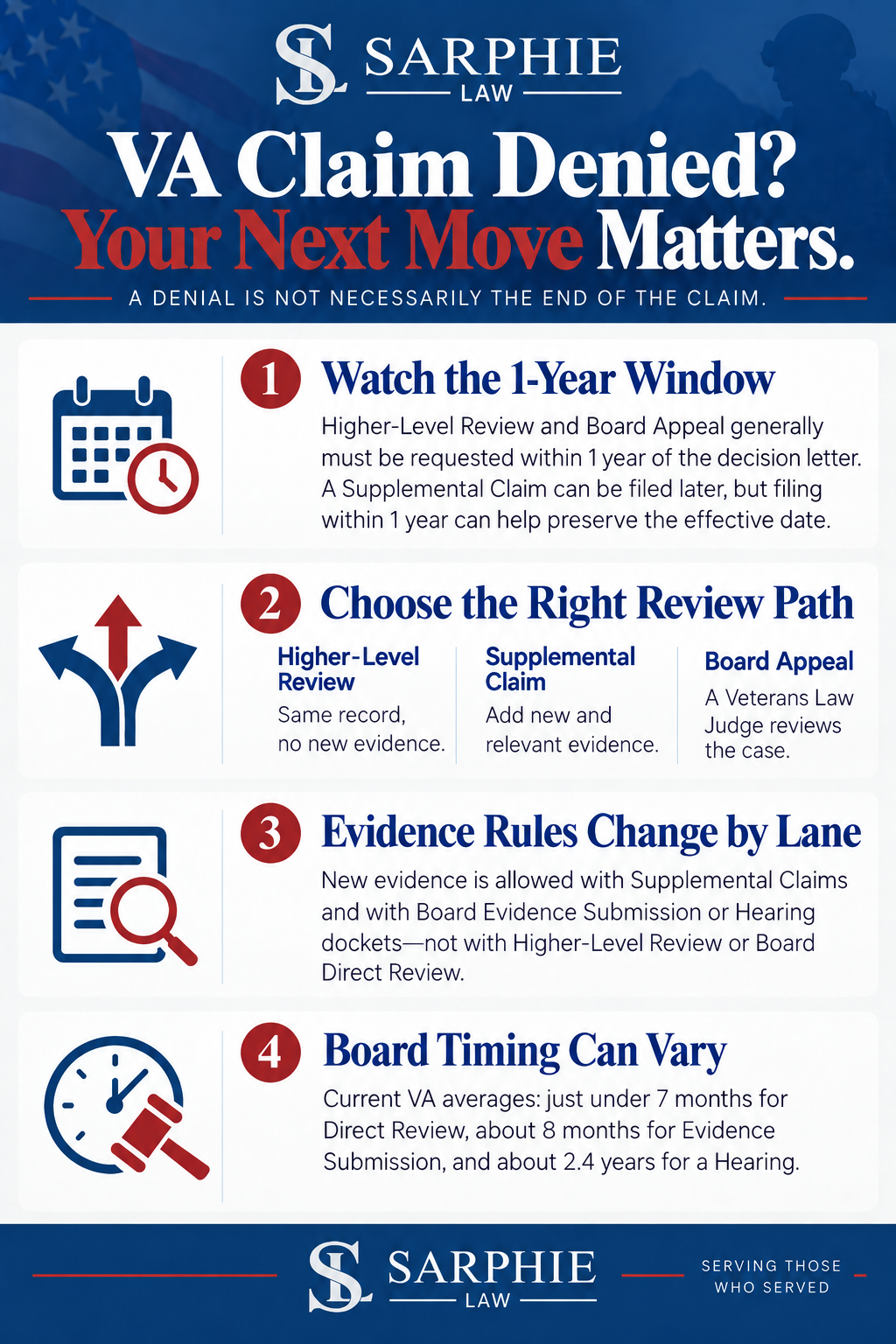
How you respond to a VA claims denial can impact whether you are successful in receiving the benefits that you deserve. A lawyer can help you determine what type of appeal to pursue and can explain the benefits and risks of each course of action. Your lawyer may assist you with preparing your paperwork and ensure you provide the appropriate and complete information. Many veterans are fighting their claim denials and winning! You must take calculated steps to make your appeal a success. Daren Sarphie is a lawyer handling VA claim denials. There are time limits to pursuing an appeal, so contact us for a case review and get legal help right away.

