Lawyer Daren Sarphie helps veterans pursue the benefits they have rightfully earned. When a mistake in a past decision by the Department of Veterans Affairs (VA) has deprived a veteran of benefits, a Clear and Unmistakable Error (CUE) filing may provide a path to correcting the record and securing retroactive compensation.
Because CUE claims are rare and often misunderstood, working with an experienced CUE VA claim lawyer is crucial. At Sarphie Law, we provide detailed case reviews, identify errors that meet the CUE standard, and fight to ensure that veterans receive the recognition and financial support they deserve.
What Is an Unmistakable Error (CUE) Claim?
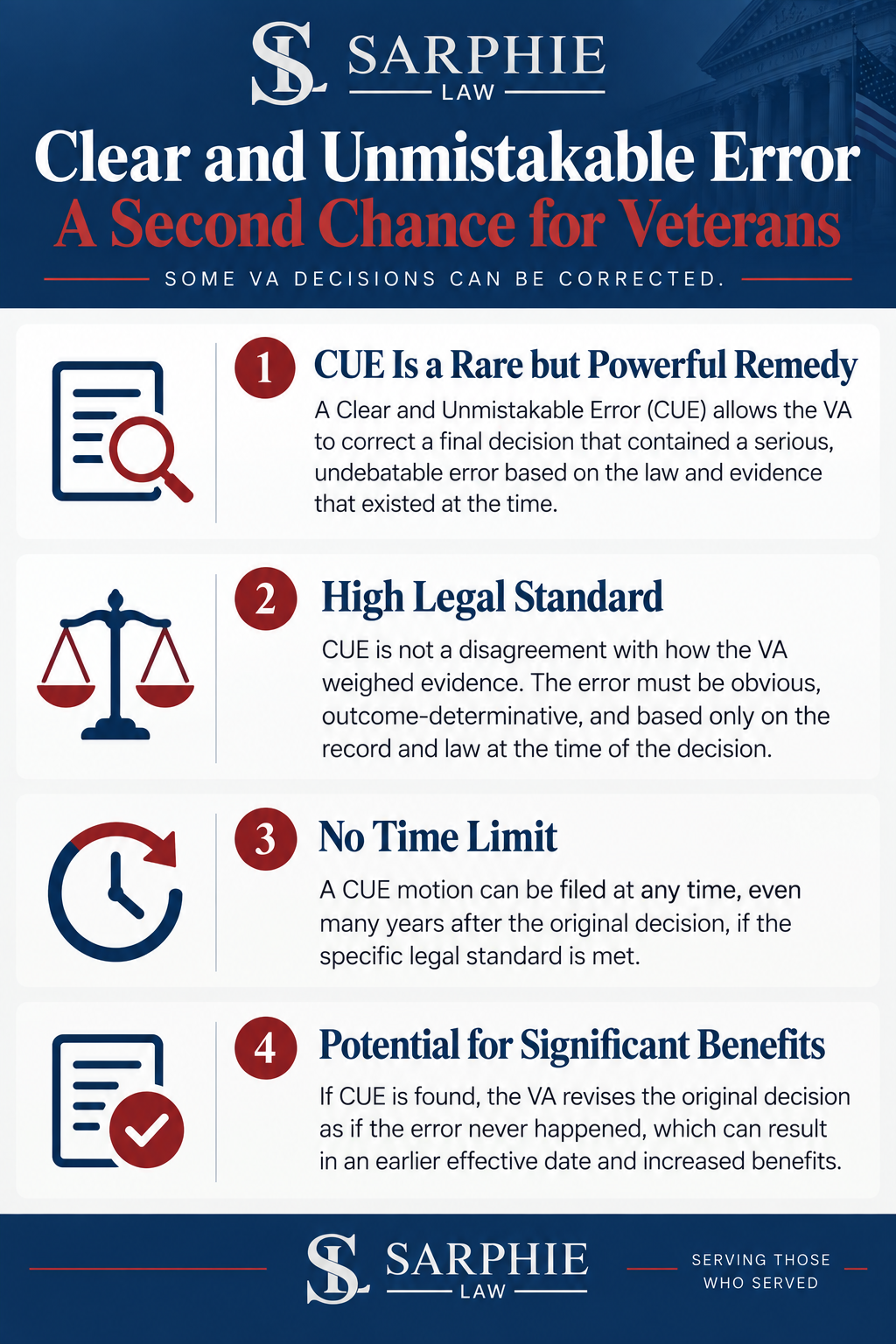
A Clear and Unmistakable Error (CUE) claim is a highly specialized legal tool that allows a veteran to challenge a final decision made by the Department of Veterans Affairs (VA). It is not simply a routine appeal or disagreement with how the VA weighed the evidence. Instead, a CUE claim directly targets a past ruling by demonstrating that the VA made an obvious and undeniable error in applying the law or facts that existed at the time of the original decision.
To qualify as a valid CUE claim, the following key elements must be met:
- Based on the law and record at the time: Veterans cannot introduce new medical records or updated evidence. The review is limited to what was already in the file when the original decision was made.
- The error must be undebatable: The mistake cannot involve interpretation or differences in opinion. It must be so clear that any reasonable adjudicator, upon reviewing the facts and law, would immediately recognize the decision as wrong.
- The outcome must have been different: Correcting the error must compel a new result, such as granting service connection, raising a disability rating, or assigning an earlier effective date.
- Not a “do-over” of the case: Veterans cannot re-argue their claim under the guise of a CUE motion. Instead, they must identify a specific factual or legal mistake that directly impacted the outcome.
- Rare but powerful: CUE claims are uncommon because they require strict legal proof. However, when successful, they can result in substantial retroactive benefits that restore what veterans should have been paid from the beginning.
If the VA ignored a service medical record that documented a back injury during active duty and denied the claim on the grounds of “no evidence of injury,” this oversight could qualify as a CUE. Since the record existed and should have been considered, the error is undebatable, and correcting it would likely change the outcome.
Why and When to Pursue an Unmistakable Error (CUE) Claim
Most veterans who are denied benefits or receive a lower-than-deserved disability rating file an appeal or supplemental claim. These processes allow them to submit new evidence, seek further examinations, or challenge the VA’s evaluation. However, there are certain circumstances where a CUE filing is the strongest, most efficient option.
Veterans may want to pursue a CUE claim when:
- The VA clearly misapplied the law: For example, if a veteran was denied service connection for an Agent Orange-related condition that was already recognized by statute at the time of the decision, the denial may qualify as a CUE.
- The VA ignored existing records: If medical evidence or service records were already in the claims file but not considered in the ruling, the failure to review them can be grounds for a CUE.
- The decision directly impacts retroactive pay: One of the biggest advantages of a CUE claim is that it can correct the effective date of benefits. Unlike traditional appeals, which generally move benefits forward, a CUE revision can reach back to the date of the original claim and provide years, even decades, of back pay.
- The decision is final and no longer appealable: A CUE claim may be the only available option when the appeal window has closed but the veteran believes the VA’s decision was undeniably wrong.
- A unique one-time opportunity: Veterans generally get only one chance to file a CUE claim on a specific issue. This makes it critical to ensure that the motion is carefully researched, properly documented, and legally precise.
- No time limits: Unlike a Notice of Disagreement or supplemental claim, which must be filed within a specific timeframe, a CUE motion can be submitted at any time, even decades after the original ruling.
Because of the high legal standard, veterans should pursue CUE claims only in cases where the error is undeniable and outcome-changing. Filing a vague or poorly supported CUE can result in permanent closure of the issue, so professional legal guidance is essential.
What Makes a CUE Claim Different From Other VA Appeals?
Veterans navigating the VA benefits system often assume that all forms of review or correction are handled through the traditional appeals process. However, a Clear and Unmistakable Error (CUE) claim is a unique and far more restrictive tool. Unlike appeals, which typically allow new evidence or arguments, a CUE motion is about holding the VA accountable for undeniable mistakes in its original ruling.
Understanding how CUE claims differ from other types of appeals is critical to deciding whether this strategy may be the right option for your case.
- Not an “appeal.” A CUE is not filed on a special VA form. Instead, it is a written motion that challenges the finality of a prior decision.
- No new evidence allowed. Unlike supplemental claims or appeals, you cannot introduce new records, examinations, or testimony. The VA reviews only what was in the file at the time.
- Based on error, not interpretation. Disagreements with how the VA weighed evidence are not valid CUE claims. Instead, the error must be a legal or factual mistake that no reasonable adjudicator would have made.
- One chance per issue. Once a CUE claim has been reviewed and decided, it cannot be refiled on the same issue.
- No statute of limitations. While appeals must be filed within a strict timeframe, a CUE can be raised at any time after the decision becomes final.
By recognizing these distinctions, veterans can better appreciate why CUE claims require precision and legal expertise. While they offer the possibility of correcting even decades-old mistakes, they also come with significant risks if filed incorrectly. Having an attorney carefully evaluate whether a CUE motion is more effective than a standard appeal can make the difference between securing long-overdue benefits and permanently losing the chance to correct an error.
How Can I Determine If I Have a Valid CUE Claim?
Not every VA mistake qualifies as a Clear and Unmistakable Error. In fact, most disputes over disability ratings or service connection fall into the category of appeals rather than CUE claims. Because the legal threshold is so high, veterans must carefully assess whether the issue they are facing rises to the level of an undebatable error. This evaluation involves asking the right questions about finality, clarity, and the potential impact of correcting the mistake.
- Was the decision final? A CUE claim only applies to final decisions that were not appealed within the allowed timeframe.
- Was the error clear and not debatable? It must be something more than a disagreement over judgment.
- Would correcting the error change the outcome? If the result would have been the same regardless, it does not qualify.
- Does the error involve fact or law? Examples include misapplication of the presumption of soundness, incorrect interpretation of service records, or ignoring evidence that was already in the file
If you find yourself uncertain about whether your case meets these demanding criteria, consulting an experienced CUE attorney is essential. A lawyer can pinpoint errors that a veteran may overlook, ensure the claim is properly framed, and avoid wasting the one opportunity to pursue a CUE on a particular issue. With professional guidance, veterans can maximize their chances of success and avoid the frustration of a denied motion.
What Are the Procedures for CUE Claims?
Unlike other VA filings that follow standardized processes and forms, pursuing a CUE claim requires navigating a much more technical and nuanced path. The VA does not provide a specific form or checklist for veterans to use, making it the claimant’s responsibility to craft a precise, well-supported motion. Because of this, understanding the procedural requirements is critical to building a claim that will not be dismissed outright.
- Drafting a detailed written request: The motion must clearly state the alleged error, identify the specific decision being challenged, and explain why the outcome would have been different.
- Filing at the right level: If the CUE relates to a decision by a Regional Office, the motion is filed with the VA office that made the original decision. If it relates to a Board of Veterans’ Appeals decision, the motion is filed directly with the Board.
- Following the rules in 38 C.F.R. § 3.105(a): These regulations outline the authority for CUE motions.
Importantly, the Court of Appeals for Veterans Claims (CAVC) does not review new CUE motions. Only the Regional Office or the Board can consider them. If the CUE motion is too general, such as simply stating “the VA made an error,” it will almost certainly be denied. Specificity is essential.
The highly technical nature of the process means that even minor mistakes, such as failing to specify the error in detail, can lead to denial. Veterans should view the procedural steps as more than administrative tasks; they are the foundation upon which a successful CUE motion is built. With legal representation, veterans can ensure their filing meets the VA’s strict standards and is positioned for the best chance of approval.
Requirements to Win a CUE Claim
Even when a veteran identifies a possible error in a VA decision, winning a CUE claim requires more than pointing it out. The law sets a very high standard for what qualifies as a clear and unmistakable error, and veterans must demonstrate that the mistake was both undeniable and outcome-determinative. By meeting strict evidentiary and legal requirements, veterans can prove that the VA’s ruling should be overturned.
- File properly: The motion must identify the decision being challenged and the exact nature of the error.
- Show the decision was incorrect: The error must be proven using only the facts and laws that existed when the decision was made.
- Identify the specific error: This could be failure to apply a presumption, misreading service records, or misapplying the rating schedule.
- Prove the outcome would have been different: The correction must compel a new conclusion, not just potentially change the result.
The precedent set in Grover v. West (1999) clarified that a CUE is not simply a disagreement but a mistake based on the record and law at the time. Veterans and their attorneys must show that the error was undebatable and that, but for the error, the outcome would have been manifestly different.
These requirements highlight why CUE claims are so rarely successful without legal assistance. They demand not only knowledge of the law but also the ability to frame the argument in a way that the VA or Board of Veterans’ Appeals cannot dispute. For veterans, working with an attorney ensures that their one chance at correcting a past error is as strong and compelling as possible, increasing the likelihood of finally securing the benefits they have long been denied.
Examples of Clear and Unmistakable Error (CUE)
Examples That May Qualify:
- Failure to apply a legal presumption (such as Agent Orange exposure or Gulf War illness presumptions).
- Ignoring the presumption of soundness, which assumes a veteran was in good health at enlistment unless proven otherwise.
- Assigning benefits based on only one condition when multiple service-connected disabilities were present.
- Overlooking medical evidence already in the file that proved service connection.
- Misapplying rating criteria or using the wrong diagnostic code.
- Incorrectly applying the burden of proof, such as requiring more evidence than the law required.
Examples That Do Not Qualify:
- The VA giving more weight to one medical opinion than another.
- General complaints that due process was not followed.
- Claims that the VA failed to assist in gathering evidence.
- Changes in medical diagnoses after the decision was made.
- Attempts to submit new evidence.
Understanding the difference between qualifying and non-qualifying claims is essential. A knowledgeable attorney can quickly identify whether your case fits the criteria.
Additional Legal Services
At Sarphie Law, we recognize that veterans and federal employees often face more than one type of legal challenge. In addition to handling CUE claims, Attorney Daren Sarphie provides a wide range of services designed to protect the rights and benefits of those who have served their country or work in federal positions. Each area of practice is handled with the same commitment to detail, advocacy, and results.
Other practice areas we handle include:
By offering comprehensive representation across multiple areas, Sarphie Law ensures that veterans and federal workers have access to experienced legal guidance tailored to their unique circumstances. Whether you need help with a disability benefits appeal, a workplace injury claim, or a retirement issue, our firm is here to advocate for you.
Contact Sarphie Law Today for Your CUE Claim
A Clear and Unmistakable Error claim is one of the most technical and challenging areas of veterans’ law. Veterans attempting to file these motions on their own often find their claims dismissed as too vague or not meeting the strict legal requirements.
Attorney Daren Sarphie has years of experience working with veterans and understands how to frame a CUE motion so that it meets the VA’s requirements. By carefully reviewing your case, identifying errors that rise to the level of CUE, and presenting a clear, persuasive argument, he can help you recover benefits that should have been granted from the start.
Veterans who have also suffered workplace injuries or are pursuing federal workers’ compensation can benefit from the same careful strategies used in CUE claims. Sarphie Law stands ready to assist veterans and their families in securing the justice and compensation they deserve.
Reviewed for legal accuracy by Daren Sarphie on September 17, 2026


