Available 24/7
phone icon
833-635-COMP

Military Sexual Trauma - MST Lawyer

red line
Lawyer Daren Sarphie helps veterans receive the benefits they deserve.

Serving veterans across Louisiana, attorney Daren Sarphie understands how one incident of sexual assault or a pattern of sexual harassment during service can derail a lifetime of plans. From his office in Metairie, Louisiana, he fights to secure full VA disability benefits, health-care coverage, and any additional relief the law allows. Whether you live in New Orleans, Baton Rouge, Shreveport, Alexandria, Lake Charles, Lafayette, Monroe, Houma, or elsewhere in Louisiana, you can count on one-on-one guidance, responsive communication, and zealous advocacy every step of the way.

Military sexual trauma (MST) is the umbrella term the U.S. Department of Veterans Affairs (VA) uses to describe any sexual assault or threatening sexual harassment experienced during military service, whether a service member is on active duty, active-duty training, or inactive-duty training. Unlike many other legal definitions, MST centers on the survivor’s experience rather than the attacker’s intent or a criminal finding. In practical terms, MST can include:

 
Category
Illustrative Behaviors
Key Points
Sexual Assault
Rape, attempted rape, forced penetration, unwanted sexual touching during hazing, coerced sexual acts during field exercises
Physical contact is not required for a behavior to qualify as MST, but when it occurs, it falls under assault.
Threatening Sexual Harassment
Persistent sexual jokes, quid-pro-quo propositions for promotions or favorable assignments, stalking, indecent exposure
The VA stresses that “threatening” harassment counts even when no physical contact happens; intimidation or fear is enough.va.gov
Coercion & Quid Pro Quo
Pressuring subordinates for dates or sex with threats of negative evaluations; promising better duty stations in exchange for sexual favors
Power dynamics, particularly within rigid command structures, make it hard for victims to refuse or report.mentalhealth.va.gov


Where and When MST Happens

  • On or off base, in the United States, overseas combat zones, or training schools.
  • During wartime or peacetime—research shows MST is as prevalent in garrison settings as it is in deployed environments.
  • Across all ranks and branches. Perpetrators can be supervisors, peers, or even civilians working alongside the military.
  • Against every gender identity and sexual orientation. Studies indicate LGBTQ+ service members experience MST at disproportionately higher rates yet underreport even more frequently.
  • Regardless of reporting. The VA does not require a police report, Uniform Code of Military Justice (UCMJ) conviction, or Article 15 proceeding to recognize MST for health care or disability benefits.

The Legal and Policy Framework Behind the Term

  • 38 U.S.C. § 1720D mandates that the VA provide confidential counseling and health services for conditions related to MST, even if the survivor is otherwise ineligible for VA health care.
  • The Department of Defense Sexual Assault Prevention and Response (SAPR) Program defines sexual assault similarly, but it focuses on criminal accountability and prevention inside the force. The VA adopted the broader term “MST” to encompass both assault and harassment for treatment and benefits purposes.
  • DoD’s restrictive reporting options (restricted vs. unrestricted) can limit evidence trails. Consequently, when pursuing VA disability compensation, survivors often rely on indirect corroboration known as “markers.”

Understanding “Markers” in MST Claims

Because many incidents never make it into official records, especially in tight-knit units where retaliation fears run high, VA adjudicators must look for circumstantial clues that something traumatic occurred. Common markers include:

  • Sudden requests for transfer or change of military occupational specialty.
  • Deteriorating performance evaluations after previously strong records.
  • Unexplained disciplinary actions or Article 15s that coincide with the time of the assault.
  • Medical visits for sexually transmitted infections, pregnancy tests, or chronic pain without clear etiology.
  • Behavioral health consultations noting anxiety, depression, or sleep disturbances soon after the event.
  • Buddy statements from roommates or battle buddies observing mood or personality changes.

A knowledgeable Louisiana MST attorney works with veterans to surface these markers, sometimes buried in unit diaries, leave-and-earnings statements, or Red Cross messages sent home, and weaves them into a persuasive narrative for VA decision-makers.

Why Many Survivors in Louisiana Never File a Formal Report

Despite reforms, survivors stationed at Barksdale Air Force Base, Belle Chasse’s Naval Air Station Joint Reserve Base, and Fort Johnson report common deterrents:

  • Fear of career repercussions in close-knit commands where the perpetrator outranks the victim.
  • Mistrust of the chain of command. Historically, commanders decided whether to prosecute sexual-assault allegations; only in 2023 did Congress transfer many of those decisions to independent military prosecutors.
  • Social isolation, especially for Guard and Reserve members who live far from large installations or VA facilities.
  • Cultural pressure to “tough it out,” reinforced by unit cohesion rhetoric.

Because federal law sets a survivor-centric evidentiary standard, you can still obtain treatment and benefits without a Uniform Code of Military Justice conviction or court-martial verdict. Attorneys like those at Sarphie Law help ensure that your lack of a formal complaint never becomes a barrier to justice.


Related: Can Male Veterans File VA Disability Claims for Military Sexual Trauma?


MST is not limited to violent assaults in war zones; it encompasses a spectrum of unwanted sexual behaviors that can occur anywhere, at any time, to anyone in uniform. Federal statutes, VA regulations, and ever-evolving DoD policies recognize these realities and provide avenues outside the criminal system for survivors throughout Louisiana to obtain health care, disability compensation, and closure.

How Can a Lawyer Assist With Your MST Case?

Although the VA has introduced dedicated MST coordinators, its claims process remains adversarial and paperwork-heavy, especially for survivors coping with PTSD, depression, or chronic pain. Attorney Sarphie provides comprehensive representation tailored to Louisiana veterans:

  1. Case investigation – collecting service records, medical files, buddy statements, and sometimes expert forensic testimony.
  2. Linking the trauma to disability – demonstrating that PTSD, anxiety, migraines, sexual-dysfunction disorders, or other conditions stem from documented MST.
  3. Navigating VA procedure – preparing the initial application (VA Form 21-526EZ), monitoring C&P exams, and responding promptly to supplemental requests.
  4. Challenging denials – filing Higher-Level Reviews, Supplemental Claims, or an appeal to the Board of Veterans’ Appeals.
  5. Exploring additional remedies – if the perpetrator was a civilian contractor or if negligent supervision contributed, Louisiana tort law may allow a separate civil suit.
  6. Protecting against retaliation – advising active-duty clients on IG complaints and whistleblower safeguards.

Attorney Daren Sarphie is a full-service lawyer for military sexual trauma survivors. When you have been harmed in the service to your country, you deserve the benefits you are due under the law. He will handle the entire process on your behalf, providing the professional counsel and compassionate representation you deserve.


How common is military sexual trauma?


How Common Is Military Sexual Trauma?

These numbers confirm what many Louisiana veterans already know: MST remains pervasive, underreported, and often mishandled. Every parish in Louisiana has residents who entered the service with hope and returned bearing invisible wounds.

What Are the Effects of MST?

MST may produce immediate injuries as well as long-term medical and psychosocial consequences:

1. Immediate & Physical Harm

  • Injuries: pelvic fractures, soft-tissue damage, bruising, chronic back or joint pain.
  • Medical concerns: emergency contraception, pregnancy, and sexually transmitted infections that may linger untreated if the survivor does not report the assault.

2. Psychiatric Disorders

  • Post-traumatic stress disorder (PTSD)
  • Major depression and generalized anxiety
  • Panic attacks and sudden surges of fear or dread

These diagnoses often coexist, amplifying overall distress and complicating treatment.

3. Cognitive Disruption

  • Intrusive memories and flashbacks
  • Difficulty concentrating, learning new tasks, or making decisions
  • Nightmares that replay the event

4. Behavioral Changes

  • Hypervigilance (always “on guard”)
  • Irritability or sudden anger outbursts
  • Emotional numbing and self-blame that erode self-esteem
  • Social withdrawal, which can lead to isolation from friends, family, and faith communities

5. Sleep Disturbances

  • Insomnia and fragmented sleep
  • Night terrors that leave survivors exhausted during the day
  • Stress-triggered sleep apnea or worsening of pre-existing apnea

6. Substance Misuse

  • Self-medicating with alcohol, opioids, or stimulants to blunt memories or manage pain
  • Increased risk of chemical dependency and overdose

7. Relationship Challenges

  • Loss of trust in intimate partners
  • Reduced libido and sexual dysfunction
  • Marital strain or divorce precipitated by communication breakdowns and mood swings

8. Occupational Impact

  • Missed promotions or adverse evaluations caused by anxiety, absenteeism, or reduced productivity
  • In severe cases, discharge from service or civilian employment, magnifying financial stress

9. Somatic (Body-Based) Symptoms

  • Gastrointestinal issues such as irritable bowel syndrome or acid reflux
  • Chronic headaches or migraines
  • Significant weight gain or loss tied to hormonal disruption or emotional eating

Finding Help in Louisiana

  • Beyond MST app: free, anonymous symptom tracker with 30+ self-help tools.
  • New Orleans VA Medical Center & Vet Center: individual and group therapy focused on MST, no VA enrollment required.
  • Local advocacy: Louisiana veterans’ service organizations can connect survivors with peer mentors and emergency housing if needed.

Early, holistic treatment paired with diligent legal documentation improves health outcomes and strengthens any VA disability claim based on MST.

Because the incident often happens far from home, many Louisiana service members return without a robust civilian support network. In response, the VA’s Beyond MST mobile app offers anonymous symptom tracking, coping tools, and goal-setting exercises.

Survivors in Louisiana can also attend individual or group counseling at the New Orleans VA Medical Center and the New Orleans Vet Center, both of which provide MST-focused therapy at no cost, even for veterans who are otherwise ineligible for VA health care.

What Compensation Is Available for Victims of MST?

VA benefits can significantly offset the economic and personal toll of MST for Louisiana veterans.

 
Type of Benefit
What It Covers
Key Takeaways for Louisiana Veterans
Disability Compensation
Monthly tax-free payments based on combined rating for PTSD, depression, physical injuries, etc.
MST-related PTSD ratings often range from 30% to 100%. Effective representation can secure earlier “effective dates,” maximizing back pay.
Special Monthly Compensation
Extra payment for severe disabilities (e.g., loss of a reproductive organ).
Attorney Sarphie documents secondary conditions common in MST survivors.
VA Health Care
Free treatment for any MST-related condition, regardless of proof requirements.
Available at seven VA clinics across Louisiana.
Vocational Rehabilitation (Chapter 31)
Job training, tuition, and employment placement.
Helps veterans re-enter the Louisiana workforce after prolonged absence.
Dependency & Indemnity Compensation
For eligible survivors if MST-related conditions contribute to a veteran’s death.
Louisiana families can pursue DIC even if the veteran never filed a claim.


Can You Receive VA Disability Pay for Military Sexual Trauma?

Yes. The VA disability system does not compensate for the assault itself; it compensates for the resulting mental or physical disability. If you develop PTSD, major depressive disorder, panic disorder, chronic fatigue syndrome, or another diagnosable condition that traces back to MST, you may qualify. The VA must apply a “liberalizing evidentiary standard,” meaning it should accept a range of corroborating evidence, not just law-enforcement reports, to grant service connection. Yet the VA historically denies a higher percentage of MST-related PTSD claims than combat-related claims, underscoring why experienced legal help is vital.


How does the military respond to MST?

The VA health system has coordinators for MST cases and issues. They recognize that sexual trauma often goes unreported, but that trauma can be seriously harmful. Medical care relating to service-connected MST is without charge, including treatment for physical and mental harm resulting from the trauma. Counseling is available in addition to other healthcare services.

The U.S. Department of Veterans Affairs has a website discussing military sexual trauma, providing examples of military sexual trauma and explaining what it is.
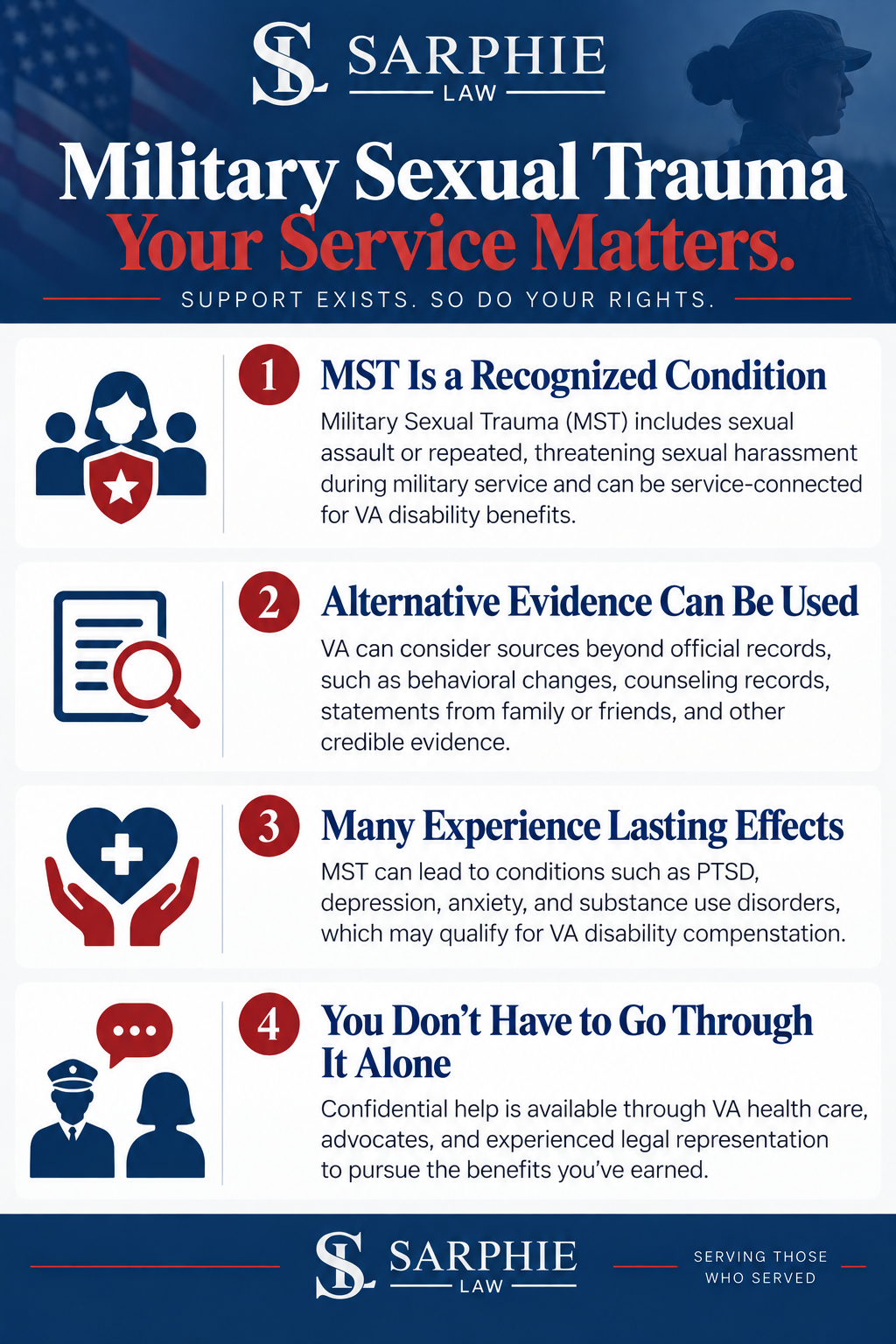
 

Contact Sarphie Law for Trusted Legal Representation

Every year, dozens of Louisiana veterans tell us the same thing: “I feel like nobody believes me.” We do. We believe you. And we have the legal tools to turn your story into documented proof that the VA cannot ignore.

  • No out-of-pocket fees: We only get paid when your VA or workers’ comp benefits increase.
  • Local roots, nationwide reach: Based in Metairie, we regularly represent clients from Bossier Parish to Plaquemines Parish and assist former Louisiana residents now living elsewhere.
  • Integrated practice: If your MST aggravated a duty-related orthopedic injury, our workers’ compensation experience helps synchronize both claims.
  • Compassionate advocacy: From Lafayette VA medical appointments to Board of Veterans’ Appeals hearings in Washington, D.C., we travel the journey with you.

Sarphie Law Firm also provides experienced legal representation in areas like:

Whether you served at Barksdale Air Force Base, Naval Air Station Joint Reserve Base New Orleans, Fort Johnson (formerly Fort Polk), or another installation, your sacrifice deserves recognition. Let a dedicated Louisiana Military Sexual Trauma lawyer fight for the benefits and dignity that you earned in uniform. Call today, and come see how we can make a difference.

Frequently Asked Questions

Veterans in Louisiana may be eligible for benefits related to MST if they can show that the trauma occurred during their military service and that it has caused lasting mental or physical health issues. Documentation from VA therapists, medical professionals, and even statements from friends and family can support a claim. Working with an MST attorney familiar with Louisiana's veterans' services can improve your chances of a successful outcome.
Yes, if your MST claim is denied, you have the right to appeal. Many Louisiana veterans find that their initial claims are rejected due to insufficient evidence or misinterpretation of their records. An experienced military sexual trauma attorney can file an appeal with additional evidence, expert testimony, or a new medical opinion to strengthen your case and fight for the benefits you deserve.
Proving a MST-related condition without a formal report is often more challenging but still possible. Evidence can include medical or mental health records showing treatment for or symptoms of trauma, statements from friends, family, or fellow service members who know what happened (lay statements), private records of therapy or self-help seeking, journals or other personal writings, and any records of behavioral changes or psychiatric evaluation. Confidentiality rules often protect victims who did not formally report, and VA recognizes that lack of formal reporting is common. A nexus opinion from a qualified mental health professional can help connect current PTSD symptoms to the military trauma event. Wearing a supportive attorney helps ensure that all relevant evidence is gathered and presented to meet VA’s standards.
Yes. The VA has certain policies recognizing the unique barriers MST survivors face. For instance, VA allows alternative forms of evidence when formal reporting did not occur and understands that trauma often remains unreported due to fear, shame, or retaliation. In claims involving MST, VA may accept private therapy records or other documentation of mental health treatment. Also, VA has regulations that ensure veterans will not be denied care solely because of lack of service records. However, survivors still must demonstrate they meet the criteria for service connection: a diagnosed condition, evidence the trauma occurred (or symptoms consistent with MST history), and linkage between the trauma and condition. Having legal help who is experienced with MST claims can help navigate VA’s MST-sensitive policies and standards.
Yes. If you have other service-connected disabilities, the VA will consider all service-connected conditions when determining your overall disability rating. MST-related mental health conditions (like PTSD or depression) can contribute to your combined rating with other physical or mental disabilities. The VA uses a combined rating table to account for more than one condition and avoid simply adding percentages. If MST worsens other conditions (for example, sleep issues, anxiety, etc.), that effect may also be considered. The rating you receive will reflect the total impact of all service-connected disabilities, not just MST alone. Proper evidence and documentation of how MST interacts with your other disabilities helps maximize accurate compensation.
If you're ready to pursue benefits for military sexual trauma, we’re here to help guide you through the legal process and ensure your voice is heard. Our MST attorney services are available throughout Louisiana, and we’re committed to advocating for your rights. Please contact us today to schedule a consultation and take the first step toward justice.

Additional Information in Metairie, LA

U.S. Department of Veterans Affairs - Military Sexual Trauma: Provides comprehensive information about Military Sexual Trauma (MST), including symptoms, treatment options, and how veterans can access free and confidential VA services nationwide.
Department of Defense – Military Justice in Sexual Assault Cases: Explains how the military justice system handles sexual assault allegations, including reporting procedures, legal processes, and the rights of service members involved in MST-related cases.
American Psychological Association – Impact of Military Sexual Trauma on Veterans: Summarizes research findings on how military sexual trauma contributes to long-term psychological effects like PTSD, particularly among female veterans, and emphasizes the need for trauma-informed care.
Contact Us

Get in touch for a case review

red line

Get In Touch

Copyright © 2025 Sarphie Law - All Rights Reserved.
Powered by:
Epic Web Results Logo
chevron-down linkedin facebook pinterest youtube rss twitter instagram facebook-blank rss-blank linkedin-blank pinterest youtube twitter instagram